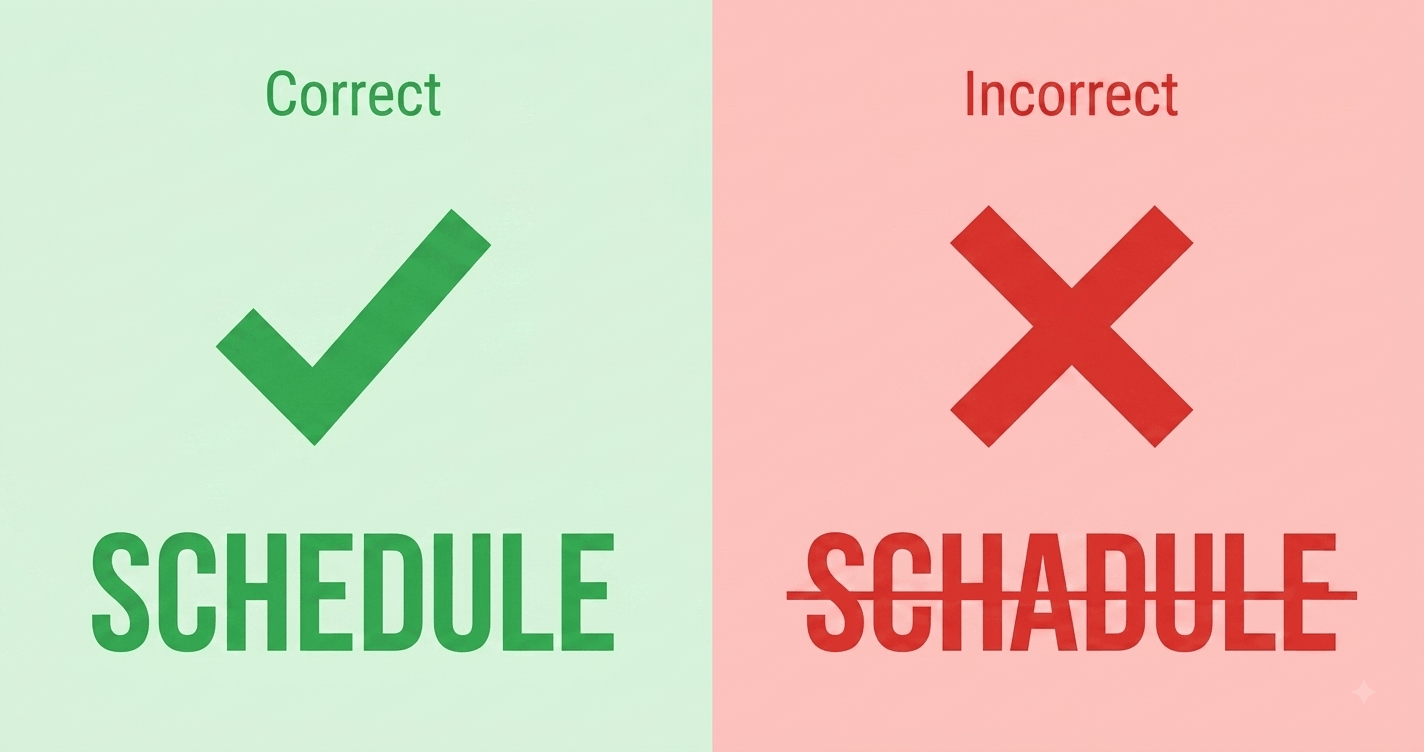
Schedule or Schadule: Which Spelling Is Correct? (The Complete Guide)
If you have ever paused mid-sentence wondering whether to write schedule or schadule, you are far from alone. Type any variation of this word into a search bar — schedule, schadule, scedule, shedule, schedual — and you will find thousands of people asking the exact same question every single day. This article settles the debate once and for all, explains why this particular word trips up so many writers, and walks through the history, pronunciation, and memory tricks that will help you get it right every time.
The Quick Answer: “Schedule” Is Correct
Let’s not bury the answer. The only correct spelling in standard English is schedule — s-c-h-e-d-u-l-e. Every other version you may have seen or typed, including schadule, schedual, scedule, shedule, skedule, and dozens of other variants, is a misspelling. It does not matter whether you are writing a work email, a school assignment, a text message, or a business report — “schedule” is the only form accepted by dictionaries, style guides, and grammar checkers in both American and British English.
A schedule refers to a plan that lays out when specific tasks, events, or activities are supposed to happen. It can describe a personal daily plan (“my schedule is full today”), a formal timetable (“the train schedule”), a list of appointments (“check the doctor’s schedule”), or even a legal or tax document (a “schedule” attached to a contract or tax return). Whatever the context, the spelling never changes.
Why Do So Many People Write “Schadule” Instead of “Schedule”?
This is where things get interesting. “Schadule” is not a random typo — it is one of the most frequently searched misspellings of this word, right alongside “schedual” and “scedule.” There are a few clear reasons this mistake happens so often.
1. Pronunciation Doesn’t Match Spelling
English spelling is famously inconsistent, and “schedule” is one of the clearest examples. <cite index=”8-1,8-2″>The confusion mainly comes from pronunciation, since American English commonly uses a “sk” sound while British English often uses a “sh” sound, even though both varieties spell the word the same way.</cite> A British speaker pronouncing it with a “sh” sound does not change the spelling, and neither does an American speaker using the “sk” sound. <cite index=”8-6,8-7″>Yet the pronunciation and spelling of English words are related but not identical, and thousands of English words have spellings that cannot be predicted perfectly from how they sound.</cite>
Because the second syllable of “schedule” is pronounced closer to “jool” or “yool” rather than sounding like the letters d-u-l-e, people who have heard the word spoken far more often than they’ve seen it written tend to guess at the spelling — and “schadule” or “schedual” feels intuitive to the ear even though it’s wrong on the page.
2. Metathesis: When Letters Swap Places
Linguists actually have a name for the specific error behind “schedual.” <cite index=”7-1″>The incorrect spelling “schedual” results from a phenomenon called metathesis, where sounds or letters within a word get rearranged — in this case, the “d” and the “u” in “schedule” swap positions, producing “schedual.”</cite> This same swapping tendency is what pushes many writers toward “schadule” as well, since the brain is essentially trying to make the unusual “dule” ending feel more familiar by reshuffling it into something that looks more like a typical English word ending.
3. Silent and Unexpected Letter Combinations
The “sch” at the start and the “dule” at the end are both unusual clusters in English. Few common words begin with “sch” the way schedule, school, or scheme do, and even fewer end in “-dule.” This rarity means your brain doesn’t have a strong, well-practiced pattern to draw on, so it’s easy to drop a letter (schedul, scedule), swap letters (schedual, schadule), or reorder the whole ending (scheudle, sheldule).
4. Typing Speed and Autocorrect Gaps
Sometimes the explanation is far simpler than linguistics. <cite index=”8-9,8-10″>When people type quickly, letters like the “c” can disappear entirely, and autocorrect doesn’t always catch the mistake — especially when the software cannot confidently identify what was intended.</cite> This is why casual writing, texting, and social media posts are full of quick misspellings such as “shedule,” “scdule,” or “schdule” that a slower, more careful writer would likely catch.
A Quick History: Where Does “Schedule” Come From?
Understanding the word’s backstory makes the strange spelling feel a lot less arbitrary. <cite index=”11-1,11-2″>The word entered English in the late 14th century as “sedule” or “cedule,” meaning a ticket, label, or slip of paper with writing on it, coming from the Old French “cedule,” which itself came from Late Latin “schedula,” meaning “strip of paper.”</cite> <cite index=”16-1”>That Latin word traces back further to Ancient Greek “skhédē,” meaning “papyrus leaf,” rooted in a Proto-Indo-European word meaning “to divide or split.”</cite>
<cite index=”15-1,15-2″>The word was originally spelled “cedule” or “sedule” and pronounced accordingly, but around the 16th century the spellings “scedule” and “schedule” began appearing in imitation of the Latin “schedula,” and by the middle of the 17th century “schedule” had become the standard written form — even though it continued to be pronounced “sedule” for roughly another two centuries.</cite> In other words, the spelling changed to look more Latin long before the pronunciation ever caught up with it, which is a big part of why the written and spoken forms of this word feel so disconnected today.
<cite index=”11-8,11-9″>The modern British pronunciation, “shed-yul,” developed under French influence, while the American pronunciation followed the pattern of words like “scheme” and “school,” giving us the familiar “sk” sound.</cite> <cite index=”19-2″>The specific “schedule” spelling we use today did not become firmly established until the mid-17th century, and the American pronunciation itself was not common until the 19th century.</cite> So next time someone insists there’s an “obvious” way to say or spell this word, you can point out that English speakers have been arguing about it for roughly 400 years.
It’s also worth noting a fun historical detail: <cite index=”11-6″>the specific meaning of “schedule” as a “printed timetable” — the sense most of us use every day — is only recorded from 1863, tied to the rise of railway travel.</cite> Before trains needed published arrival and departure times, “schedule” mostly referred to an attached list or appendix, a sense that still survives in tax and legal documents today.
Just How Common Is This Misspelling?
If you’ve ever typed “schadule” or “schedual” and felt embarrassed, the data suggests you’re in very large company. <cite index=”3-1″>Among the most frequent misspellings of this word, “scheduale” accounts for roughly 10.5% of errors, “schedual” about 8.96%, “schedu” around 7.53%, “shedule” close to 4.98%, “schedul” about 4.74%, “scedule” also around 4.74%, “schdule” near 3.68%, “shcedule” about 2.85%, “scedual” close to 2.49%, and “scheduele” around 1.66%, with the remaining share spread across dozens of other variants.</cite>
That means no single misspelling dominates — instead, this word has an unusually wide and varied “misspelling ecosystem,” which is exactly why so many different variants (schadule, scedule, shedule, schuduel, secdule, and beyond) keep showing up in searches, documents, and messages every day.
The Full List: Common Misspellings of “Schedule”
Below is an extensive list of the misspelled variations people commonly type or search for instead of the correct word. If you’ve used one of these, don’t worry — you now know the fix.
Missing or dropped letters: schedu, schedul, schdule, scedule, shedule, sedule, hedule, chedule, chedual, scdual, scedual, scedul, schdual, schdul, schdeule, schecule, schedle, schedle, schedua, schedi, secdual, secdule
Letter-swap (metathesis) errors: schedual, schadule, schedaule, scheadule, scheudal, scheude, scheuld, scheudle, schuale, sechudle, sceudule, sceudle, scudual, scuduel, scuedle, sceudal
Extra or doubled letters: scheddule, schedulle, sschedule, scchedule, schedulke, scheduele, scheduyle, schedulde, schecdule, schedhule, scheduile
“Sh” vs “sch” confusion (pronunciation-based): shedule, shcedule, shecdule, shechdule, shecudule, shecudle, sheduele, sheldule, shcudule, shudel
“Sk” or “sc” confusion: skedule, squedule, sxhedule, xchedule, wschedule, sceudule, scduel
Reordered vowels/consonants: schedle, schedua, sechulde, schulde, sechdule, seculde, seduce (a real word, but not this one!), scudual
Other common variants seen in everyday typing: scedual, sceduele, schedule., schedule’, schedul e, scheldue, schuelde, scheuald, schedaule, secedual, secedule, seducle
Whichever version you’ve typed by accident, the correction is always the same eight letters in the same order: s-c-h-e-d-u-l-e.
Simple Tricks to Never Misspell “Schedule” Again
Because this word doesn’t follow predictable phonetic rules, memory tricks work far better than “sounding it out.” Here are a few reliable methods.
- Break it into two familiar chunks. Think of “sch” (as in school or scheme) plus “edule.” <cite index=”5-4,5-5″>Focus on the “sch” at the beginning followed by “edule,” emphasizing the “e” sound rather than the “u” sound, since the word is often mispronounced or misspelled around that middle vowel.</cite>
- Link it to “module.” <cite index=”4-2″>Try thinking of “schedule” in line with “planned module” to help you remember the “dule” ending rather than an incorrect “dual” ending.</cite>
- Remember it isn’t a duel. <cite index=”4-4″>Recall the word “duel” (a fight) and remind yourself that a “schedual” is wrong, just as a duel isn’t part of your daily plan — the correct word ends in “-dule,” not “-dual.”</cite>
- Count the letters. <cite index=”4-5″>A schedule organizes “times,” and the correctly spelled word simply has more letters than the shorter, incorrect “schedual.”</cite> If your written version looks noticeably shorter than eight letters, double-check it.
- Picture a calendar. <cite index=”4-3″>Associate the word “schedule” with a visual image of a calendar or timetable each time you write it, which helps your brain link the correct spelling to the correct meaning rather than to the sound alone.</cite>
- Say it, then write it separately. Because pronunciation is part of the problem, try writing the word from memory without saying it out loud first, then check it against a dictionary or spell-checker.
“Schedule” in a Sentence
Seeing the word used correctly in context can reinforce the spelling far more effectively than memorizing rules alone. A few natural examples:
- Please send me the updated project schedule by Friday.
- Our flight schedule was delayed because of the storm.
- I need to schedule a meeting with the marketing team next week.
- The doctor’s schedule is completely full until next month.
- Due to construction delays, the building work fell behind schedule.
- Two more debates were scheduled for the coming weeks.
- Can you check the train schedule for any last-minute changes?
- We finalized the schedule the night before the launch.
Notice that the word works as both a noun (a schedule, the schedule) and a verb (to schedule something, it was scheduled).
Related Word Forms You Should Know
Once you’re confident with the base word, it helps to recognize its most common variations, since misspellings often creep into these forms too:
- Scheduled — past tense/adjective (“The event is scheduled for Monday.”)
- Scheduling — present participle/gerund (“She is scheduling the interviews now.”)
- Schedules — plural noun or third-person verb (“Check both schedules before booking.”)
- Rescheduled — moved to a new time (“The flight was rescheduled to next week.”)
- Unscheduled — not planned in advance (“We had an unscheduled stop.”)
- Scheduler — a person or tool that arranges schedules (“Use the online scheduler to book a slot.”)
All of these forms keep the same core spelling — “schedul-” — so once you lock in the base word, the rest follow naturally.
“Schedule” vs. Similar Words: Don’t Mix Them Up
Part of the confusion around this word also comes from mixing it up with related — but different — words:
- Schedule vs. Timetable: These are near-synonyms. “Timetable” is more common in British English for transportation and school contexts, while “schedule” is used more broadly, especially in American English.
- Schedule vs. Agenda: An agenda usually lists topics to be discussed in a meeting, while a schedule lists times and events more broadly.
- Schedule vs. Itinerary: An itinerary is a schedule specifically for travel, listing stops, dates, and destinations in order.
- Schedule vs. Calendar: A calendar is a broader system for tracking dates; a schedule is the specific plan of activities placed within that calendar.
Understanding these distinctions can also help you avoid accidentally blending spellings or usages when writing quickly.
Does the Spelling Ever Change by Region?
No — and this is worth emphasizing because it’s a common point of confusion. <cite index=”8-3,8-4″>While a British speaker may pronounce “schedule” with a “sh” sound, that does not turn the word into “shedule,” and similarly, an American speaker’s “sk” pronunciation doesn’t create a different spelling either.</cite> Regional accents affect how the word sounds, never how it’s written. Whether you’re writing for a British, American, Australian, or Canadian audience, the correct spelling remains a single, universal form: schedule.
Why Getting This Right Matters
It might seem like a small detail, but spelling accuracy carries real weight, especially in professional and academic writing. <cite index=”7-6,7-7″>Using the correct spelling adds a level of professionalism and credibility to written and spoken English, and institutions such as employers and language examiners expect accuracy in spelling as part of demonstrating strong command of the language.</cite> A single misspelled word like “schadule” in a resume, business proposal, or formal email can distract a reader from your actual message and create an impression of carelessness — even when the content itself is strong.
On the flip side, mastering a genuinely tricky word like this one is a small but satisfying win. Once “schedule” becomes automatic, you’ll find that other irregular English words become easier to tackle too, because you start recognizing the same underlying patterns: silent influences from Latin or Greek roots, pronunciation shifts that never quite matched the spelling, and the natural human tendency to reorder awkward letter clusters.
Frequently Asked Questions
Is “schadule” ever acceptable in informal writing? No. Even in texts, social media, or casual notes, “schadule” is simply a misspelling. It may not always be flagged by autocorrect, but it is never considered correct in any recognized English dictionary.
Why does spell-check sometimes miss “schadule” or “schedual”? Some misspellings are close enough to real words, or common enough as typos, that certain autocorrect systems either fail to catch them or “correct” them into the wrong nearby word. It’s always safer to proofread manually for words you know you struggle with.
Is “schedule” pronounced differently in America and Britain? Yes. <cite index=”5-6″>Generally, “schedule” follows the British English pronunciation of “shed-yool” and the American English pronunciation of “sked-yool,” but the spelling stays the same in both cases.</cite>
What other words are commonly misspelled for similar reasons? <cite index=”5-3″>Words like “necessary” and “separate” are also frequently misspelled because of their own unusual letter combinations, much like “schedule.”</cite> If you tend to misspell “schedule,” it’s worth double-checking these words too.
Is there a shortcut to remembering the spelling permanently? The most reliable method is repetition paired with a memory trick — pick one mnemonic from this guide (the “module” link or the “not a duel” trick tend to work best) and use it consistently until the correct spelling becomes automatic.
Why This Word Trends So Heavily in Search Engines
If you look closely at online search behavior, “schedule or schadule,” “schedule vs schedual,” and similar comparison queries appear constantly. There’s a simple explanation: this is one of a small group of English words where the gap between how it sounds and how it’s spelled is wide enough that even confident, educated writers pause before typing it. Students writing class schedules, employees requesting a “work schedule,” project managers building a “project schedule,” and travelers checking a “flight schedule” or “train schedule” all run into this word daily — which means the misspelling problem never really goes away. It resets every time someone new encounters the word in a hurry.
This is also why so many spelling and grammar websites, dictionaries, and blogs have entire pages dedicated purely to “schedule vs schedual” or “schedule vs shedule” comparisons. The demand for clarity is constant, precisely because the correct spelling never becomes “intuitive” the way it does for more phonetic English words.
How Scheduling Tools and Apps Use This Word
Beyond spelling accuracy, the word “schedule” shows up everywhere in modern digital life — often in ways that make correct usage even more important. Calendar apps, project management tools, appointment booking platforms, and workplace communication software all rely on this exact word in menus, buttons, and notifications: “Schedule a meeting,” “View my schedule,” “Add to schedule,” “Reschedule event.” Because these interfaces are used by millions of people daily, an incorrect spelling like “schadule” would immediately look unprofessional or even broken to users, which is one more reason software companies, HR departments, and educators are so consistent about using the standard form.
If you regularly build documents, timetables, or calendars for work or school, it’s worth taking the extra ten seconds to double-check this word before hitting send, especially in:
- Job applications and resumes, where a “flexible schedule” or “work schedule” often appears in the experience or availability section
- Emails coordinating meetings, interviews, or calls
- School or university assignment calendars and syllabi
- Travel documents such as flight, train, or bus itineraries
- Business proposals and project timelines
- Tax and legal paperwork, where “schedule” refers to attached forms or appendices
A Simple Self-Test
Before you finish reading, try this quick exercise. Cover the earlier sections of this guide and write the word from memory five times, based purely on how you’d normally type it. Then compare each attempt letter by letter against the correct spelling: s-c-h-e-d-u-l-e. If any of your attempts came out as schadule, schedual, scedule, shedule, or any other variant from the list above, don’t worry — that’s exactly the pattern this guide is designed to break. Repeat the exercise once a day for a week, and you’ll likely notice the correct spelling becoming automatic far faster than you’d expect for such an irregular word.
It can also help to keep a small personal list of words you regularly misspell — schedule being a strong candidate — and review it occasionally. Many professional writers and editors do exactly this, since even native English speakers never fully “graduate” from occasionally needing a spelling refresher on tricky, non-phonetic words.
Final Takeaway
Between “schedule” and “schadule,” there is only one winner: schedule. Every other version — schadule, schedual, scedule, shedule, skedule, and the many dozens of variants covered in this guide — is a common but incorrect alternative that stems from centuries of mismatched pronunciation, an unusual Latin-influenced spelling, and the brain’s natural tendency to rearrange tricky letter clusters. Now that you understand exactly why this word causes so much trouble, and you have a handful of memory tricks to fall back on, you should never have to second-guess yourself the next time you sit down to write your schedule.