Chalazion vs Stye: What’s the Difference? (A Complete Guide)
Waking up with a red, swollen bump on your eyelid can be alarming — and one of the first questions most people ask is whether it’s a stye or a chalazion. The chalazion vs stye comparison confuses a lot of people because both conditions look almost identical in their early stages: a lump on the eyelid, some redness, and mild swelling. But once you understand how and why each one forms, telling them apart becomes much easier.
In this guide, we’ll break down the stye vs chalazion vs hordeolum terminology (yes, “hordeolum” is simply the medical name for a stye), explain the causes, symptoms, treatment options, and when you should see a doctor — plus how conditions like blepharitis tie into both.
Quick Answer: Chalazion vs Stye at a Glance
Before diving into the details, here’s the short version of the chalazion vs stye difference:
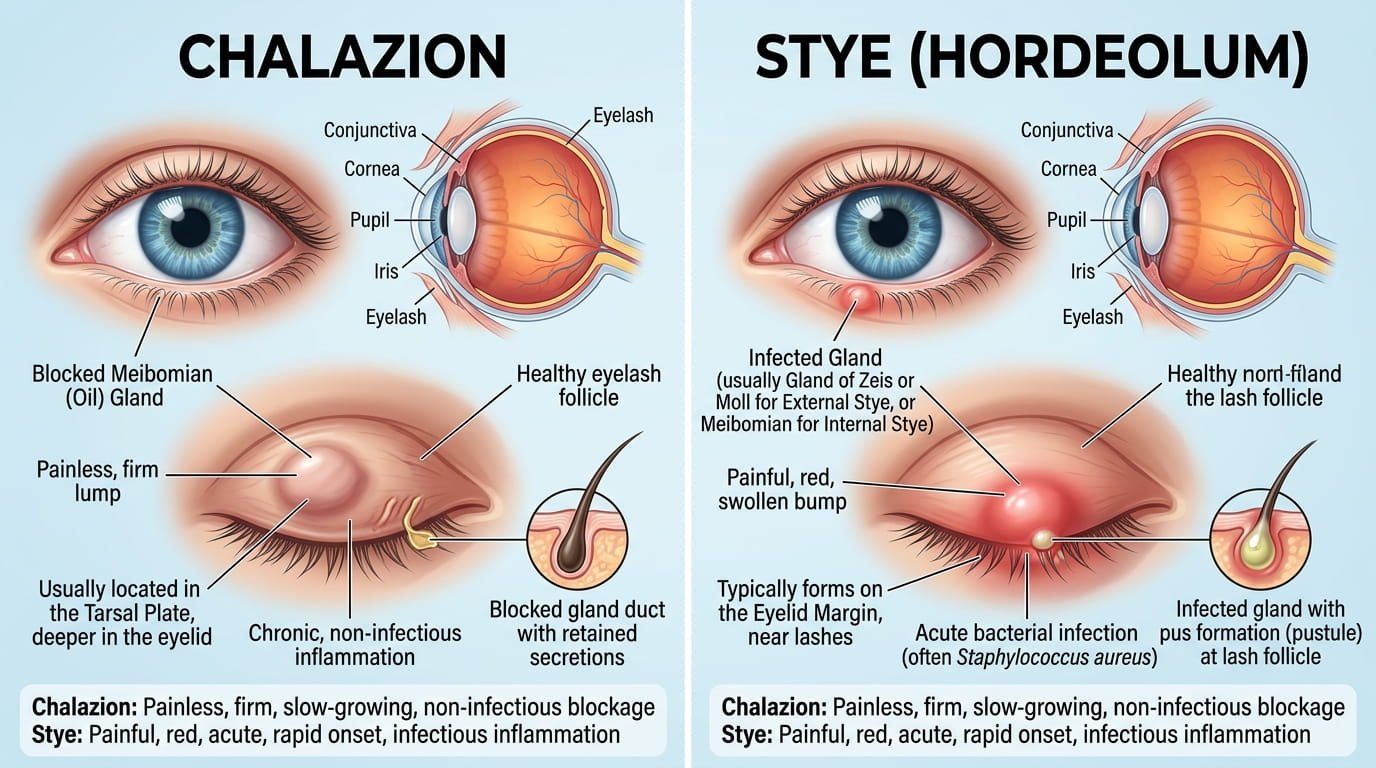
- A stye (hordeolum) is a painful, red, infected bump that forms at the edge of the eyelid, usually at the base of an eyelash. It’s caused by a bacterial infection.
- A chalazion is a usually painless, slow-growing bump that forms farther back on the eyelid, away from the lash line. It’s caused by a blocked oil gland (not an active infection).
Both conditions happen because of the same underlying structures — the tiny oil glands and eyelash follicles on your eyelid — but the mechanism behind each one is different, and that difference shapes everything from pain level to treatment.
What Exactly Is a Stye (Hordeolum)?
When people search stye vs hordeolum vs chalazion, they’re often surprised to learn that “stye” and “hordeolum” are the same thing — hordeolum is just the clinical term doctors use.
A stye develops when a bacterial infection — most commonly Staphylococcus aureus — takes hold in an eyelash follicle or one of the small oil-producing glands near the lash line. The infection causes the gland to swell, fill with pus, and become tender.
There are two types worth knowing about when comparing internal stye vs chalazion and external styes:
- External stye: Forms in a gland connected to an eyelash follicle, right at the edge of the eyelid. This is the classic, visible red bump most people picture.
- Internal stye: Forms deeper, in a meibomian (oil) gland inside the eyelid. It may not be as visible from the outside and can sometimes be mistaken for a chalazion because of its deeper location and similar appearance.
Stye Symptoms
- A red, swollen bump at the eyelid margin, near the lashes
- Noticeable pain and tenderness, especially when touched
- Watery eyes or excess tearing
- A gritty, “something in my eye” sensation
- Crusting along the eyelid
- Occasionally, a small yellowish head that may drain on its own
- In more significant cases, swelling of the entire eyelid
Styes tend to come on quickly — often within a day or two — and usually reach their worst point before starting to improve.
What Exactly Is a Chalazion?
A chalazion forms when a meibomian gland (one of the oil glands lining your eyelid) becomes blocked. Unlike a stye, there’s typically no active bacterial infection driving it — it’s the blockage and resulting inflammation that create the bump. This is a key part of the chalazion vs stye differences that dermatologists and ophthalmologists point to again and again.
Because there’s no infection, a chalazion usually:
- Develops more slowly, over days to weeks
- Appears farther back on the eyelid, away from the lash line
- Is not painful (though it can feel tender if it grows large)
- Doesn’t usually cause redness in its early stages, though the skin over it may redden as it grows
- Is more common on the upper eyelid, likely because the upper lid has roughly twice as many oil glands as the lower lid
Interestingly, one of the most searched questions — chalazion vs internal stye, or “can a stye turn into a chalazion?” — actually has a real clinical answer: yes. If an internal stye doesn’t fully drain or resolve, the residual blocked material can harden and form a chalazion. So a chalazion can sometimes be the aftermath of an unresolved stye rather than a completely separate event.
Chalazion Symptoms
- A firm, round bump on the eyelid, usually painless
- Slow, gradual growth over one to several weeks
- Mild redness or swelling of the skin over the bump (not always present)
- Heaviness in the eyelid if the chalazion grows large
- Blurred vision, in rare cases, if a large chalazion presses on the surface of the eye
- Little to no discharge or crusting, unlike a stye
Chalazion vs Stye vs Hordeolum: Clearing Up the Terminology
Because this trio of terms — hordeolum vs chalazion vs stye — shows up so often in searches, here’s a simple breakdown:
| Term | What It Means |
|---|---|
| Stye | The everyday, common name for an infected eyelid bump |
| Hordeolum | The medical/clinical term for a stye (same condition) |
| Chalazion | A distinct, non-infectious blocked oil gland — not another name for a stye |
So when you see chalazion vs hordeolum vs stye used together, remember: hordeolum and stye are two names for one condition, while chalazion is the separate condition being compared against it.
Side-by-Side Comparison: Stye vs Chalazion Differences
Here’s a detailed comparison table covering stye vs chalazion differences symptoms causes treatment — the exact breakdown most people are looking for.
| Feature | Stye (Hordeolum) | Chalazion |
|---|---|---|
| Cause | Bacterial infection | Blocked oil (meibomian) gland, non-infectious |
| Location | Edge of eyelid, near lash line | Farther back on eyelid, away from lashes |
| Pain | Usually painful and tender | Usually painless |
| Onset | Rapid (1–2 days) | Gradual (days to weeks) |
| Appearance | Red, swollen, sometimes with a pus-filled head | Firm, round lump; may or may not be red |
| Discharge/crusting | Common | Uncommon |
| Healing time | About 1–2 weeks | A few weeks to a month, sometimes longer |
| Contagious | Not contagious person-to-person, but good hygiene still matters | Not contagious |
| Typical treatment | Warm compresses, sometimes topical or oral antibiotics | Warm compresses, gentle massage, occasionally steroid injection or minor surgery |
What Do They Look Like? (Chalazion vs Stye Pictures Explained)
Since many people search for chalazion vs stye pictures or stye vs chalazion images to visually compare the two, here’s a description of what to look for if you don’t have a reference photo handy:
- A stye typically looks like a small, angry, red pimple-like bump sitting right at the base of the eyelashes. The surrounding skin is often inflamed, and you may see a tiny yellow or white “head,” similar to a pimple, especially as it matures.
- A chalazion looks more like a smooth, round lump underneath the skin of the eyelid, set back from the lash line. It often doesn’t look red or angry at all — it can simply look like a firm bump beneath otherwise normal-looking skin, somewhat like a small pea or bead sitting under the eyelid surface.
If you’re trying to self-diagnose using eye chalazion vs stye images online, keep in mind that early-stage lesions of both types can look strikingly similar — this is actually true even for eye doctors. In fact, in its initial stages, a chalazion can be clinically indistinguishable from a hordeolum. Time is often the best diagnostic tool: if the bump is painful and near the lash line, it’s more likely a stye; if it’s painless and set back on the lid, it’s more likely a chalazion.
The Blepharitis Connection: Blepharitis vs Stye vs Chalazion
A huge number of searches combine all three terms — blepharitis vs stye vs chalazion, blepharitis chalazion vs stye, or stye vs chalazion vs blepharitis symptoms — because these conditions are closely linked, even though blepharitis is technically a different problem altogether.
Blepharitis is chronic inflammation of the eyelid margins, often caused by bacteria, clogged glands, or skin conditions like rosacea and seborrheic dermatitis. It’s not a bump — it’s an ongoing irritation of the eyelid edge that causes:
- Red, swollen eyelid margins
- Flaking or crusty debris at the base of the lashes
- A gritty or burning sensation
- Eyelids that stick together, especially after sleep
Here’s why blepharitis matters in this conversation: blepharitis increases the risk of developing both a stye and a chalazion. Chronic eyelid inflammation disrupts normal oil gland function and creates an environment where bacteria can thrive and glands can become blocked more easily. If you get frequent styes or chalazia, underlying blepharitis or meibomian gland dysfunction is often the root cause — and treating that underlying issue is key to reducing how often new bumps appear.
Other Look-Alikes: Chalazion vs Stye vs Conjunctivitis, Pink Eye, Milia, and More
Because eyelid and eye-area bumps can have several causes, it’s worth briefly separating chalazia and styes from other conditions people sometimes confuse them with:
- Chalazion vs stye vs pink eye (conjunctivitis): Conjunctivitis is inflammation of the conjunctiva (the clear membrane covering the white of the eye and inner eyelid), causing redness, discharge, and irritation across the whole eye surface — not a localized bump. It’s also often contagious, unlike styes and chalazia.
- Chalazion vs stye vs milia on eyelid: Milia are tiny, hard, white cysts that form just under the skin, often on the eyelid, and are unrelated to oil gland blockage in the meibomian glands. They’re generally smaller, whiter, and more superficial than a chalazion.
- Stye vs chalazion vs xanthelasma: Xanthelasma are soft, yellowish, flat plaques that form near the inner corners of the eyelids due to fat/cholesterol deposits — very different in appearance and cause from either a stye or chalazion.
- Chalazion vs stye vs dacryocystitis: Dacryocystitis is an infection of the tear duct sac, located near the inner corner of the eye rather than on the eyelid itself, and typically comes with more significant swelling and discharge near the nose-side of the eye.
If a bump doesn’t fit the typical pattern of a stye or chalazion — for example, it’s not painful or going away, it’s changing shape, or it’s bleeding — it’s worth having it checked, since in rare cases what looks like a stubborn chalazion or stye can turn out to be something else entirely, including a skin lesion that needs a biopsy.
Chalazion vs Stye Treatment: What Actually Works
The good news in the stye vs chalazion treatment conversation is that first-line treatment for both conditions overlaps significantly.
Home Treatment (First Line for Both)
- Warm compresses: Soak a clean washcloth in warm (not hot) water and hold it against the closed eyelid for 10–15 minutes, three to five times a day. This softens the blocked oil or pus, helping the gland drain naturally.
- Gentle eyelid massage: After a warm compress, a very light massage over the area (with clean hands) can help encourage drainage, particularly for chalazia.
- Eyelid hygiene: Diluted baby shampoo or a specialized eyelid cleanser can help keep the lash line clean, especially if blepharitis is a contributing factor.
- Avoid makeup and contact lenses until the bump has healed, to reduce irritation and the risk of spreading bacteria.
- Never squeeze or pop it. This is one of the most important rules for both conditions — popping a stye or chalazion can push infection deeper or damage the surrounding tissue.
When Medical Treatment Is Needed
For a stye:
- If it doesn’t improve within a week or two, a doctor may prescribe topical or oral antibiotics, especially if the infection appears to be spreading.
- Occasionally, a doctor will make a small incision to help a stubborn stye drain.
For a chalazion:
- If it’s large, persistent, or affecting vision, a doctor may recommend a steroid injection to reduce inflammation and shrink it faster.
- For chalazia that don’t resolve after several weeks to months, minor in-office surgery (incision and curettage) is a well-established option. It’s performed under local anesthesia, usually through an incision on the inner surface of the eyelid, so there’s no visible external scar. Most people return to normal activities within a day or two.
Healing Timeline
- Styes typically clear up within one to two weeks, especially with consistent warm compress use.
- Chalazia tend to take longer — usually a few weeks to a month, and sometimes longer for larger ones. Chalazia can also recur; studies have reported recurrence rates in the range of roughly 25–40% for people who have already had one.
When to See a Doctor
While most styes and chalazia resolve on their own or with simple home care, it’s time to see an eye doctor if you notice:
- The bump keeps growing or hasn’t improved after 1–2 weeks of consistent home treatment
- Vision changes or blurriness
- Swelling that spreads beyond the eyelid to the surrounding face
- Fever, or the eyelid becomes increasingly red, hot, and painful (possible signs of a more serious infection like cellulitis)
- Recurrent styes or chalazia in the same spot
- A bump that bleeds, changes shape, or doesn’t look like a typical stye or chalazion
An eye doctor can confirm the diagnosis, rule out rarer look-alike conditions, and recommend a treatment plan suited to your specific case — particularly important if you’re dealing with an infected chalazion vs stye situation where a chalazion has become secondarily infected and now shares features of both conditions.
Can Chalazia and Styes Be Prevented?
Neither condition is contagious from person to person, but a few habits can lower your risk of developing either one:
- Wash your hands before touching your eyes or eyelids
- Remove eye makeup thoroughly before bed and avoid sharing eye makeup or applicators
- Replace old mascara and eyeliner regularly
- Clean your eyelids daily if you have a history of blepharitis or meibomian gland dysfunction
- Don’t sleep in contact lenses, and keep lenses and cases clean
- Manage underlying skin conditions like rosacea or seborrheic dermatitis, which can contribute to blepharitis
A Few More Comparisons Worth Knowing
Chalazion or stye vs. herpes in the eye: Ocular herpes (herpes simplex keratitis) is a viral infection that affects the cornea or surrounding tissue, and it looks quite different from a stye or chalazion. Instead of a firm, localized bump, herpes-related eye infections usually cause clusters of small blisters on the eyelid skin, along with eye redness, light sensitivity, and sometimes a dendritic (branching) ulcer visible on the cornea during an eye exam. If you notice blister-like clusters rather than a single firm bump, or if the eye itself (not just the lid) is painful and light-sensitive, this points away from a simple stye or chalazion and toward a viral cause that needs prompt evaluation.
Chalazion vs stye in dogs: Eyelid bumps aren’t unique to humans — dogs can develop meibomian gland tumors, styes, and chalazion-like cysts too. The same general logic applies: a painful, red, rapidly appearing bump is more likely an infected gland (similar to a stye), while a slow-growing, firmer, less painful lump is more consistent with a blocked gland or benign growth. Because dogs can also develop true tumors of the eyelid glands, any persistent eyelid lump on a pet should be evaluated by a veterinarian rather than compared informally to human chalazion or stye pictures.
“Are chalazion vs stye” questions on medical exams (USMLE-style): For students studying ophthalmology basics, the classic exam distinction is: hordeolum = acute, painful, infectious, located at the lid margin near a lash follicle or gland of Zeis/Moll; chalazion = chronic, painless, granulomatous inflammation of a blocked meibomian gland, located away from the lid margin. Remembering “infection versus inflammation” and “margin versus deeper in the lid” covers the majority of exam-style questions on this topic.
What people say on forums (stye vs chalazion reddit discussions): A common theme in online patient communities is uncertainty in the first few days, since — as ophthalmologists themselves note — early lesions can look alike. The most frequently repeated advice mirrors clinical guidance: start warm compresses immediately, avoid touching or popping the bump, and give it one to two weeks before assuming it needs medical intervention. People who’ve had recurrent chalazia often mention that consistent eyelid hygiene and treating underlying blepharitis made a noticeable difference in how often new bumps appeared.
Frequently Asked Questions
Is a chalazion the same as a stye?
No. While both are bumps on the eyelid caused by blocked oil glands, a stye is an active bacterial infection, while a chalazion is a non-infectious blockage. A chalazion can sometimes develop from an unresolved stye, but they aren’t the same condition.
Can a chalazion turn into a stye, or vice versa?
A stye that doesn’t fully resolve can leave behind hardened material that develops into a chalazion. It’s less common, but a chalazion can occasionally become infected, at which point it may take on stye-like symptoms such as pain and redness.
Which is more painful, a stye or a chalazion?
Styes are typically more painful because they involve active infection and inflammation right at the sensitive eyelid margin. Chalazia are usually painless unless they grow large enough to create pressure or tenderness.
Do styes and chalazia go away on their own?
Yes, in most cases. Styes often clear within one to two weeks, while chalazia may take a few weeks to a month. Warm compresses speed up healing for both.
Should I pop a stye or chalazion myself?
No. Attempting to pop or squeeze either one can push bacteria or debris deeper into the tissue, potentially worsening the problem or causing scarring.
Final Thoughts
At the core of the chalazion vs stye debate is one key distinction: a stye is an infection, and a chalazion is a blockage. That single difference explains nearly everything else — why one hurts and the other usually doesn’t, why one appears near the lash line and the other sits farther back, and why treatment approaches, while overlapping in the basics (warm compresses first), diverge when medical intervention becomes necessary.
If you’re ever unsure which one you’re dealing with — especially if the bump is large, painful, affecting your vision, or simply not improving — an eye doctor can make an accurate diagnosis and get you on the right treatment path quickly.
This article is for informational purposes only and is not a substitute for professional medical advice. If you have concerns about an eyelid bump, please consult an ophthalmologist or optometrist.